The window of tolerance

Annabelle Denmark, MA LPCC • July 19, 2023

How knowing your window of tolerance can help you
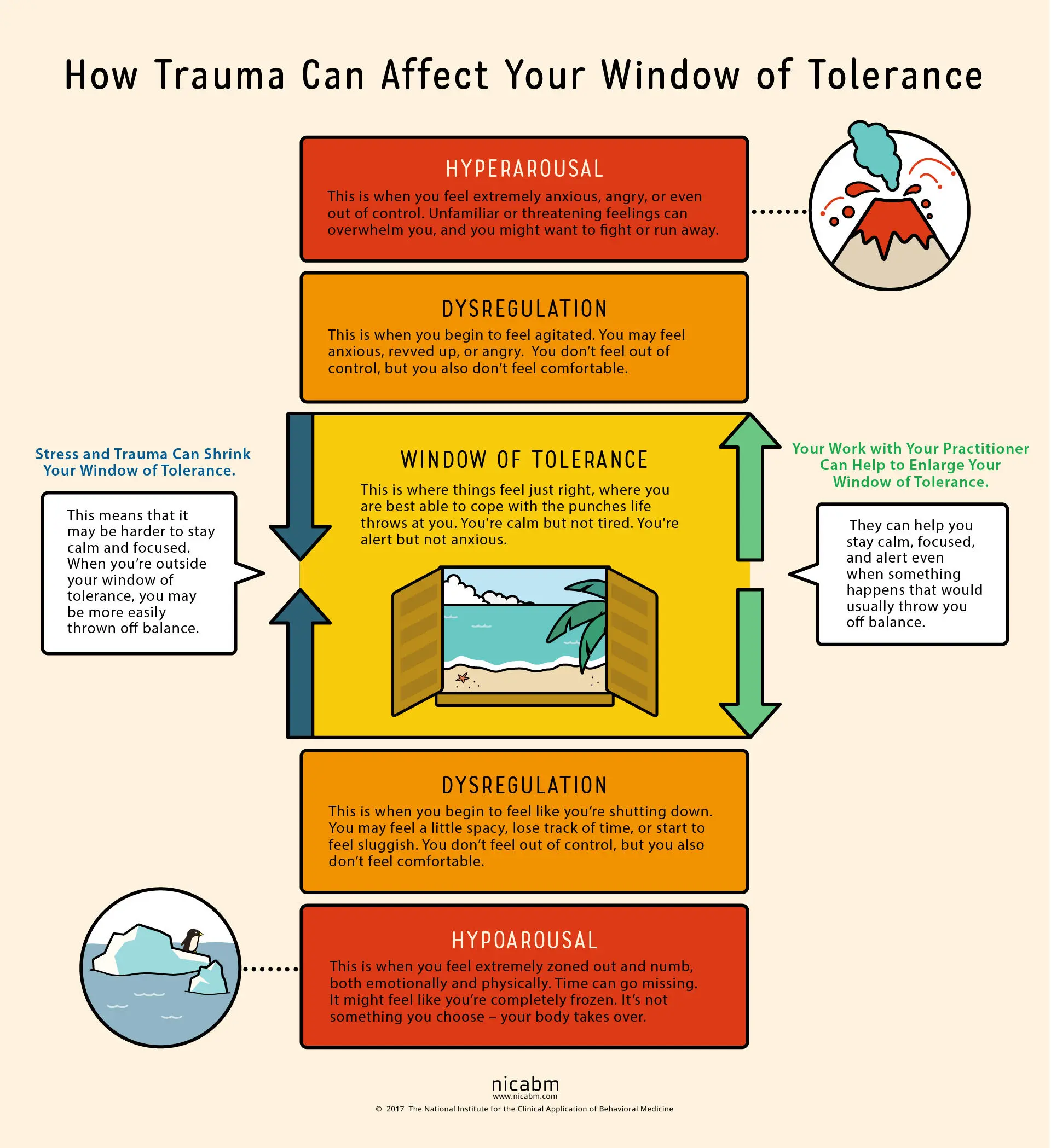
illustration of the window of tolerance


Being in the window

Imagine yourself walking outside. You notice the fresh snow on the ground, the wind blowing in your hair. Maybe you feel a little cold while enjoying the sunshine. You feel pleasure in walking outside, a sense of well-being that shows, perhaps as a light tingle in your jaw, a feeling of expansion in your chest, a small smile on your face.

You are in your window of tolerance: a space of well-being and connection. A space where you can communicate with other, you notice things about yourself, you can think, feel, connect.

Even if things feel imperfect, even if your life is not going exactly how you wants it to go, you feel good.


And then….

 And then something happens. It could be that you slip on ice and fall in the mud, ruining your outfit for the day, bruising you, making you late for your next appointment.

The activating event can last a second, or a few hours, weeks, or even months for some people. You could lose your job, suffer a loss or a breakup, survive a traumatic event, or going through on-going trauma.

You are feeling more and more activated. The more the disruptions happen, the more upset you become. Perhaps you feel angry, impatient, anxious, maybe you feel some physical pain, or numbness. When you feel more and more of the activation, your window of tolerance shrinks.


There is a point in which you leave your window of tolerance and feel the emotions overwhelming you. You enter a space of dysregulation. It is difficult to think and feel at the same time: you think less and feel more.


What does that mean?


It means that even when small inconveniences happen, some that “normally” would not bother you, you find yourself angry, disconnected, numb…. in a way that is disproportionate to the event. It could also mean that you don’t know why you feel angry, disconnected, or numb. When your window of tolerance is narrow, you could feel that way every day, not knowing why.


The size changes

The size of your window can shrink or expand, depending on you circumstances and coping mechanisms. The window shrinks with trauma, repeated triggers, repeated stress, a loss of control etc.


The size of your window can expand when you find connection with other, find meaning in your life, develop coping mechanisms that work for you, work with your therapist, experience joy.


What to do to expand your window of tolerance, step by step


1. Notice/ map what your activating events are, and what happens in your body/mind when you feel activated. You can do that by keeping a journal, send texts to yourself, or just do a quick check in throughout the day by asking the following questions:

“What is going on around me?”

“What do I currently feel?”

“Are the events and my emotions connected? How?”

“What is happening in my body?”

“What’s my story around it?”


2. Scale your level of activation and corresponding event (if you can): 1 for low activation, 10 for fight/flight/freeze. The number is different for each of us and for each event!


3. Start listing what helps you feel good: reading, music, dancing, talking to friends.

Start listing what distraction can temporarily alleviate your pain: social media. Drinking, smoking

Start listing what can increase your dysregulation (arguing, people pleasing)


4. Talk to your therapist about strategies in increasing regulating behaviors, decreasing dysregulating behaviors, and processing the stories you create around the events. 


When you understand what creates activation, how those activations show up and what you can co do decrease them, you will start increasing your window of tolerance.


The content of this blog is based on my personal and clinical experience. It is not a diagnostic tool. If you suspect you might have ADHD, please seek assessment by a qualified professional.  For more information about who i am, check out the about me page. For more info about what I do, check out the services page. And contact me here


December 16, 2025
How creating a space for your anger can help you cope with being around people you don't really want to be around
November 22, 2025
I’ve pulled together a holiday wishlist full of things that actually help — not the “must-have productivity bullet journal” hype, but real tools that me and people in my little ADHD-community lean on. Some of these are sensory, some are calming, some are just practical for a brain that forgets where it put its keys… again. This list is not sponsored — these are things that have brought relief or joy to real neurodivergent folks, myself included. My ADHD Gift Guide: What to Ask For (or Treat Yourself To) 1. Books & Workbooks The Anti-Planner If you’ve tried all the planners and they just end up collecting dust: this is for you. It’s not a dated planner — think of it more like an activity workbook for procrastinators. There are games, prompts, and low-pressure strategies to help you actually start stuff, even when motivation is MIA. It’s a favorite because it meets you where you are. Dani Donovan / Anti-Planner+1 Where to buy: You can order The Anti-Planner directly from the author’s site. Dani Donovan / Anti-Planner (Note: be careful of knockoffs.) Reddit+1 2. Fidgets & Sensory Tools Little Ouchie Grippie — This is one of our top picks in the office. It’s spiky, but in a grounding way — great for emotional regulation, calming down, or just giving your hands something to do when your brain is all over the place. Square Magic Dice — This is the fidget I can’t stop playing with. There’s a little hidden gem inside: a spinning-top spring surprise. It’s simultaneously weirdly magic and deeply satisfying. 3. Nervous System + Bedtime Support Pulsetto Vagus‑Nerve Device — Okay, full disclosure: I’m skeptical about how effective it is. BUT — I use it every night. The soundtrack, the ritual, the feel — it’s comforting. Pulsetto uses gentle vagus-nerve stimulation to help you relax, reset, and (supposedly) sleep better. 4. Grounding + Anxiety Soothers Bearaby Organic Cotton Weighted Blanket — Weighted blankets are a classic, and this one is dreamy. Soft knit cotton that’s breathable, but still gives that comforting hug. Perfect for calming down racing thoughts or overactive nerves. 5. Practical Lifesavers for the Forgetful Brain Apple AirTag — This is basically my “where are my keys? where’s my phone?” insurance. I’ve got like ten of these floating around, and on stressful days, “Find My” is my lifeline. 📝 A Few Other Beloved Ideas Beyond the main items, here are some bonus favorites from clients: Mini sensory stones or palm pebbles (textured, smooth, grounding) Visual timers (e.g., time-block timers) like the time timer A sunrise / gentle alarm clock (for less jarring wakeups) Noise-canceling headphones if the world feels too loud A self-care workbook (unplanner style) to track moods, energy, and needs 💬 Why These Items, Specifically I didn’t choose these just because they’re “trendy ADHD gifts.” Instead: These are things that people in my therapy space or IRL community actually use . They support emotional regulation , sensory needs , executive functioning , or daily brain stuff — not just productivity for the sake of “being busy.” Many are tools , not “fixes.” They’re not magic cures, but they help make life a little more manageable. ⚠️ Disclaimer This is just a personal list, curated from me + my clients. I’m not a product reviewer or a scientist — I’m a therapist + ADHD person. I cannot guarantee that these will “work” for you. Use your own judgment for anything with health or sensory implications. None of this is sponsored or affiliate-linked (unless you find links later, that’s your call — but not mine).
self portrait, green and yellow visual distortion
By Annabelle Denmark LPC May 1, 2025
This post is for therapists in training and clients who would like to know a bit more about how I show up in session.